For offshore wind developers, uncertainty in seabed conditions has consequences that extend from the first route selection exercise through to cable installation and operational maintenance. The depth and continuity of sediment layers, the presence of shallow rock or buried obstructions, and the potential for seabed levels to change all influence whether a cable can be installed, protected and operated as intended. These conditions are only partially understood when many significant project decisions are made. Engineering therefore needs to establish how much confidence can reasonably be placed in the available ground information, which decisions are sensitive to the remaining uncertainty, and where further investigation could materially change the proposed solution.
A seabed described as “sand” on a regional map may contain a relatively thin surface layer over stiff clay, gravel or rock, with the depth of those interfaces varying along the cable corridor. That distinction matters because the material visible at the seabed may represent only a small part of the ground through which a burial tool must operate. British Geological Survey research highlights the complexity of shallow seabed geology and the limitations of simplifying layered ground into a single soil classification. For cable engineering, the relevant description needs to extend through the depth affected by installation and protection requirements, identifying the properties and interfaces that could alter the feasibility of the design.
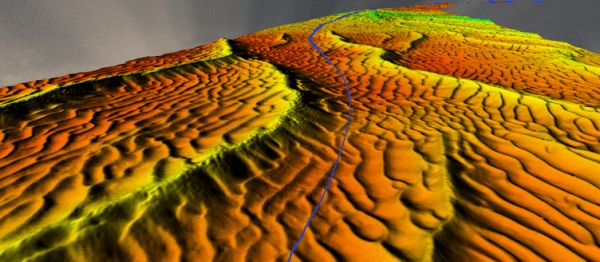
The quality of that interpretation depends on how geological, geophysical and geotechnical evidence is brought together. Bathymetry establishes seabed morphology, while sub-bottom profiling can help interpret shallow stratigraphy; cores, samples and cone penetration tests provide local evidence of material characteristics and engineering behaviour. Each dataset has limitations in coverage, resolution or penetration, and an interpreted boundary between investigation locations remains an interpretation. An integrated ground model should make those limitations visible, distinguishing measured conditions from inferred continuity and recording where alternative interpretations remain credible. The Crown Estate’s guidance on surveys for offshore wind transmission cables describes this integration as a foundation for route and installation planning, with the ground model developing as further information becomes available.
For route selection, the practical question is whether a different interpretation of the ground would change the preferred corridor or installation approach. A shorter route may pass through an area where shallow rock is poorly constrained, while a longer alternative may offer more consistent burial conditions but introduce additional cable length, crossings or environmental constraints. Those options need to be compared using credible installation scenarios and their consequences for the programme, protection requirements and cost. Where the route preference depends heavily on an assumed depth to a difficult layer, targeted investigation has a clear purpose: to establish whether that assumption is sufficiently reliable to support the decision. CIGRE’s guidance on submarine cable installation identifies soil and rock conditions, obstacles, seabed slopes and existing infrastructure among the factors that need to inform route engineering.
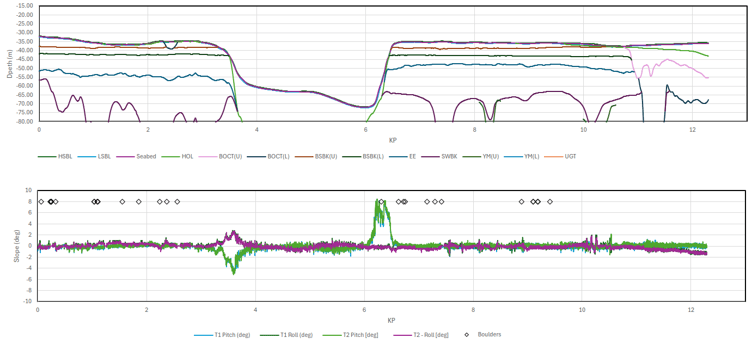
Burial requirements introduce another distinction that is essential to sound decision-making: the protection the cable requires and the depth that can practically be achieved are related, but separate, engineering questions. A Cable Burial Risk Assessment considers the threats relevant to the route and the protection needed to reduce risk to an agreed level, while a burial and trenching assessment considers the feasibility of delivering that protection in the anticipated ground. Uncertainty in soil conditions can affect both assessments, influencing predictions of external threat penetration as well as burial tool performance. The Carbon Trust’s CBRA guidance provides a structured approach to assessing risk and residual risk, but the resulting recommendation still depends on the quality of the project inputs and the assumptions used. A burial depth should therefore remain traceable to its threat assessment and ground interpretation as those inputs develop.
Installation planning then needs to translate the interpreted ground into realistic expectations of equipment performance. Jetting, ploughing and mechanical cutting respond differently to soil strength, density, particle size, cementation and layering, and suitability cannot be established from a broad sediment label alone. A tool that performs well through most of a route may encounter a short section that requires another method, an additional pass or supplementary protection. Tekmar’s burial and trenching assessment approach considers soil conditions and route characteristics when evaluating installation methodologies. A useful outcome for the developer is an assessment that identifies the sections controlling installation risk, explains the confidence in the predicted conditions and defines what evidence would trigger a change in approach.
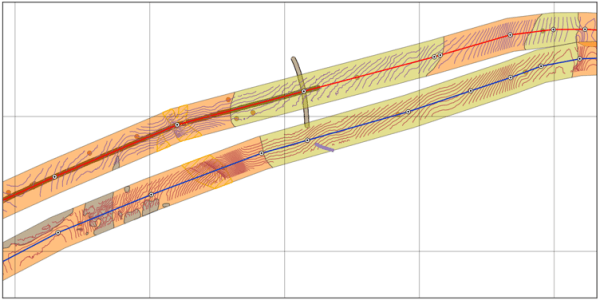
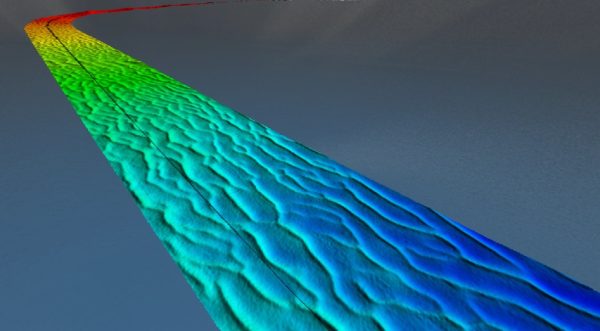
Seabed mobility adds a time-dependent uncertainty that cannot be resolved by understanding the installation conditions alone. Sandwave migration, erosion and deposition can change the relationship between the cable and the seabed after installation, potentially reducing cover or increasing the thickness of sediment above the cable. A burial assessment referenced only to the surveyed seabed level may therefore provide an incomplete picture of protection over the asset’s life. The engineering assessment needs to consider the available evidence for bed-level change and explain how that evidence informs the selected burial reference surface, protection approach and inspection strategy. ORE Catapult’s seabed mobility guidance identifies future seabed profiles as an important consideration for offshore installations, including the potential exposure of previously buried cables.
This makes precision in burial specifications particularly important. The project should define the reference surface and the point on the cable used for each depth measurement, and distinguish the cable’s achieved lowering from the sediment cover present above it. An installation record showing that a cable reached the specified elevation does not, by itself, establish the condition of the trench backfill or demonstrate that the same cover will remain throughout operation. Acceptance criteria should connect the design requirement with what installation and post-installation surveys can actually verify. Where uncertainty remains, it should be carried into the asset management plan with a defined basis for further inspection or intervention, rather than disappearing when the installation scope is closed.
Thermal performance creates a further interface between seabed interpretation and cable design. The ability of a buried cable to dissipate heat depends partly on the thermal properties of the surrounding material and its burial configuration, so a deeper installation can have implications for current rating as well as physical protection. The electrical assessment needs representative thermal inputs and an understanding of whether installation will disturb or change the material surrounding the cable. The Carbon Trust’s guidance on soil thermal properties addresses investigation, testing and interpretation for subsea cable design, including conditions before and after installation. Developers should ensure that burial and thermal assessments use compatible assumptions, particularly where uncertain layering or future sediment accumulation could affect the design case.
The most useful response to seabed uncertainty is a focused assessment of which missing information could change a material project decision. Additional investigation is easier to justify where it could alter the route, equipment selection, protection quantities or cable rating than where it would simply add detail to a decision that remains unchanged across the credible range of conditions. This requires the engineering team to test alternative ground scenarios, identify their consequences and agree when the evidence is sufficient to proceed. The same discipline should continue through procurement and installation, so that new observations can be compared against the design assumptions and acted on before they become unmanaged changes to scope or programme.
Tekmar’s Engineering Services bring together integrated ground modelling, route engineering, Cable Burial Risk Assessment, burial and trenching assessment, and installation analysis to support these connected decisions. For developers, the value lies in establishing a defensible relationship between what is known about the seabed and what the project commits to designing, procuring and installing. Bringing that work into project development while meaningful choices remain available allows uncertainty to be investigated, accommodated in the design or managed through explicit contingency, with the reasoning retained for the teams responsible for delivery and long-term asset performance.